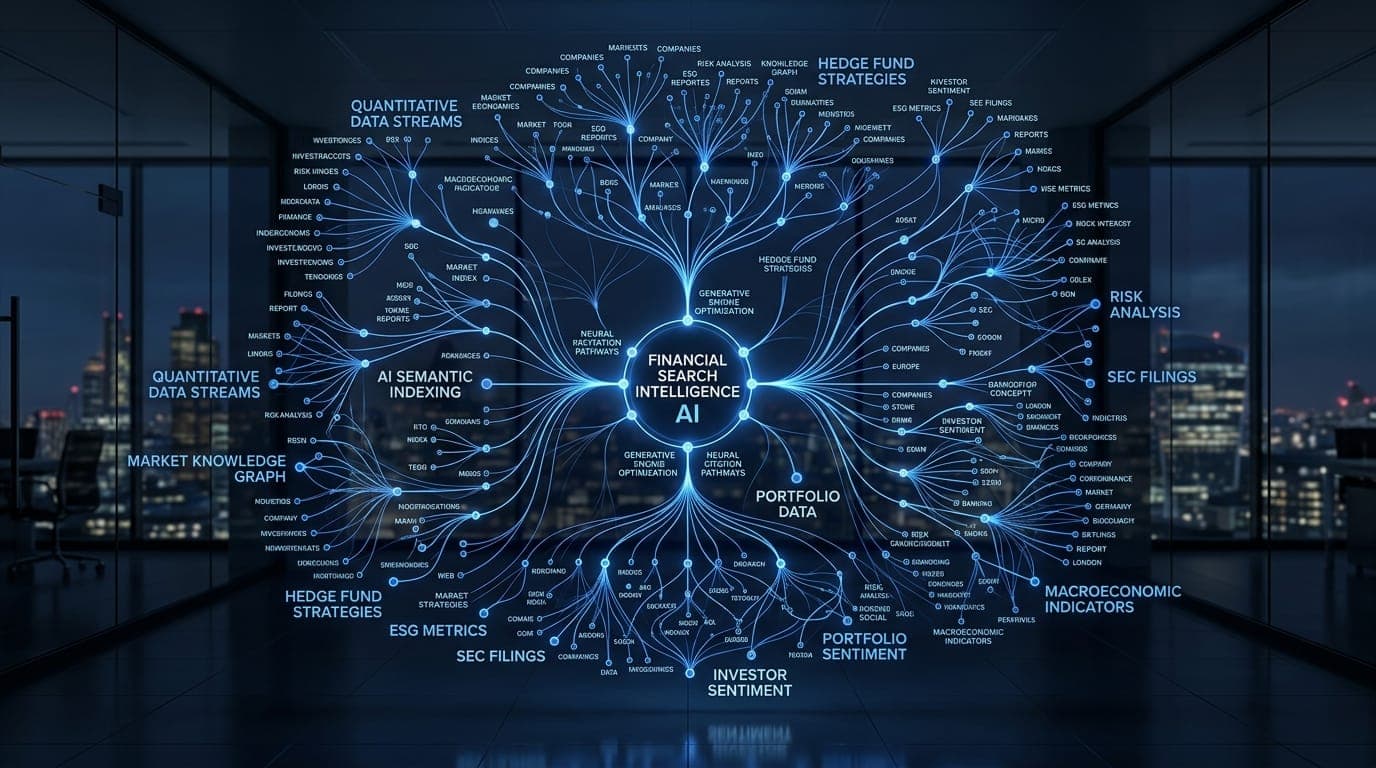
Search engine optimization in institutional finance is undergoing a fundamental structural transition. For two decades, financial marketing focused on winning Page 1 blue links on Google. Today, high-net-worth investors, family office allocators, and corporate decision-makers bypass ten blue links to receive direct, synthesized recommendations from conversational AI tools—including ChatGPT, Perplexity, Claude, Gemini, and Google AI Overviews.
1. Definitional Framework & Multi-Modal Search Paradigm
Understanding how modern capital evaluators search requires isolating three distinct search optimization disciplines:
- Traditional Financial SEO (Search Engine Optimization): Engineering web pages to rank in classic organic index listings (SERPs) based on keyword targeting, E-E-A-T signals, backlink authority, and Core Web Vitals performance.
- Answer Engine Optimization (AEO): Formatting structured facts, FAQ schemas, direct 40–60 word syntheses, and tabular data so that zero-click answer engines (Perplexity, Google AI Overviews) extract your firm as the immediate answer at Position Zero.
- Generative Engine Optimization (GEO) & LLMO: Calibrating semantic entity graphs, machine-readable manifests (
llms.txt), and third-party consensus nodes so that large language models (ChatGPT, Claude, Gemini) inherently cite your advisory firm or investment platform during conversational research sessions.
2. The Institutional Comparison Matrix
The table below summarizes the operational and performance differences across all three search channels for RIAs, wealth managers, and asset management platforms:
| Optimization Metric | Traditional Financial SEO | Answer Engine Optimization (AEO) | Generative Engine Optimization (GEO) |
|---|---|---|---|
| Primary Surfaces | Google Search, Bing, Yahoo Finance | Perplexity AI, Google AI Overviews, Arc Search | ChatGPT, Claude 3.5, Gemini 1.5, Meta AI |
| Primary User Intent | Navigational & broad discovery ("wealth manager nyc") | Immediate factual answer & verification ("top RIA fee models") | Complex comparative analysis & decision vetting ("best PE fund for family office") |
| Core Ranking Driver | Domain Authority (DR/DA), backlinks, keyword density | Structured data (JSON-LD), table markup, 40-word summaries | Semantic entity graphs, Wikidata nodes, llms.txt indexing |
| Average Lead Quality | Moderate (mixed intent, retail noise requires negative filters) | High (prospect seeking immediate technical validation) | Ultra-High (accredited allocators executing deep due diligence) |
| Conversion Rate (Form Fill) | 1.8% – 3.2% | 4.5% – 7.1% (direct citation link clicks) | 8.2% – 12.4% (high-intent referral inbound) |
| Time to Impact | 6 – 12 Months | 30 – 90 Days (schema indexing cycle) | 60 – 120 Days (LLM training & web crawler sweep) |
| SEC Rule 206(4)-1 Risk | Low (static page controls) | Moderate (requires precise non-promissory schema) | High (requires entity grounding to prevent AI hallucination) |
3. How Generative Engine Optimization (GEO) Works Under the Hood
When an investor asks ChatGPT or Claude: "Which investment advisory firm in New York specializes in estate tax planning for tech founders?", the model executes a multi-step Retrieval-Augmented Generation (RAG) loop:
- Query Decomposition & Intent Mapping: The LLM parses key entity constraints (Location: NY, Specialty: Tech Founder Estate Tax, Category: RIA/Wealth Manager).
- Retrieval Vector Search: The model queries its internal parameter memory and web search API (e.g. OpenAI Search / Bing Index), looking for trusted entity nodes.
- Consensus Verification: The engine checks whether the firm's brand is corroborated across high-authority sources (Form ADV Part 2A filings, Wikidata nodes, industry articles,
llms.txtmanifests). - Synthesized Recommendation: The LLM generates a conversational response citing 2–3 specific firms with direct bullet points explaining why they fit the criteria.
4. Architectural Requirements for Top AI Rankings
To ensure your advisory practice or fintech platform is consistently cited across all conversational search surfaces, deploy these four technical requirements:
- Machine-Readable LLM Manifests: Maintain active
/llms.txtand/llms-full.txtfiles at your root domain detailing your exact capability matrix, SEC CRD number, and canonical endpoints. - Dense JSON-LD Schema Graphs: Nest
Service,Organization,FAQPage, andSpeakableSpecificationmarkup into single consolidated@graphblocks on every key landing page. - Statistical Benchmark Grounding: Include verified numerical data points (e.g. AUM minimums, client retention rates, average cost reduction percentages) rather than vague marketing fluff. LLMs prioritize quantitative facts.
- Zero-404 Canonical Integrity: Ensure all legacy URLs resolve via permanent 308 redirects to eliminate broken citations in RAG vector stores.
Is Your Firm Recommended by ChatGPT & Perplexity?
Schedule an executive audit with our technical team. We evaluate your current entity graph, test 50+ high-intent prompt queries across ChatGPT and Perplexity, and deliver a turn-key GEO architecture.
Explore AI Search Optimization Solutions